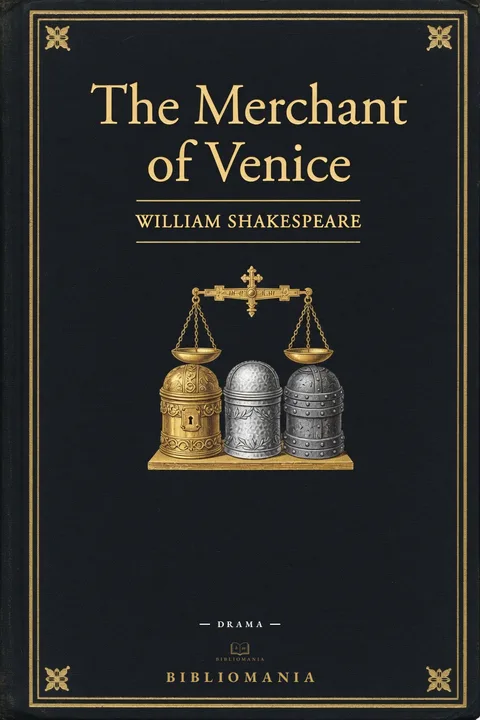
Merchant of Venice
Summary
The Merchant of Venice is a comedy written by Shakespeare somewhere between 1596 and 1598 and printed in 1600, taken in the main from Fiorentino's Il Pecorone ('The Blockhead'), Day 4 Story 1. Its comic elements are now less easy to perceive due to well-justified post-World War II distaste for anti-Semitism. The key figure now rarely seen as purely comic is Shylock, a reprehensible Jewish usurer. In fact, Shakespeare is unlikely to have intended him to be the central character of the play at all. The story revolves around two main events: the winning of the beautiful Portia by a test involving gold, silver and lead caskets and the borrowing of 3000 ducats by noble Bassanio from his merchant friend Antonio. Antonio in turn has to borrow this sum from Shylock and after a spell of ill fortune at sea he cannot pay the money back. As such, the evil Shylock demands a pound of flesh from the debtor. Portia, now wedded to Bassanio, dresses up as an advocate and defends Antonio in court by claiming that Shylock may have his pound of flesh but may not legally spill blood in doing so or he will forfeit his life. The cunning of Portia and her servant Nerissa is consistently inspired and amusing, while the comeuppance of Shylock is undeniably just and satisfying. These days Shylock can be played as a tragic character rather than a comical devil, but this does little for the play which is clearly designed to be amusing rather than harrowing. The matter continues to provoke debate.
Table of contents
- Dramatis Personae.
- Scene 1.
- Scene 2.
- Scene 3.
- Scene 1.
- Scene 2.
- Scene 3.
- Scene 4.
- Scene 5.
- Scene 6.
- Scene 7.
- Scene 8.
- Scene 9.
- Scene 1.
- Scene 2.
- Scene 3.
- Scene 4.
- Scene 5.
- Scene 1.
- Scene 2.
- Scene 1.
More by William Shakespeare
Other Drama classics
- Provoked Wife — Sir John Vanbrugh
- Misanthrope — Moliere
- Country Wife — William Wycherley
- Bonduca — Beaumont and Fletcher
- Plays by Moliere — Moliere
- Beggar's Opera — John Gay