trust to our honour,” as East proudly informs Tom; “they know very well that no School-house boy would cut the match. If he did, we’d very soon cut him, I can tell you.”
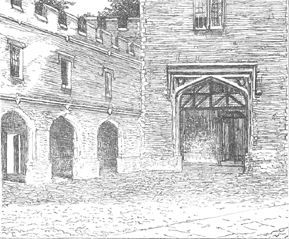
The Close
The master of the week being short-sighted, and the præpostors of the week small and not well up to their work, the lower school boys employ the ten minutes which elapse before their names are called in pelting one another vigorously with acorns, which fly about in all directions. The small præpostors dash in every now and then, and generally chastise some quiet, timid boy who is equally afraid of acorns and canes, while the principal performers get dexterously out of the way; and so calling-over rolls on somehow, much like the big world, punishments lighting on wrong shoulders, and matters going generally in a queer, cross-grained way, but the end coming somehow, which is after all the great point. And now the master of the week has finished, and locked up the big school; and the præpostors of the week come out, sweeping the last remnant of the school fags—who had been loafing about the corners by the fives’ court, in hopes of a chance of bolting—before them into the close.
“Hold the punt-about!” “To the goals!” are the cries, and all stray balls are impounded by the authorities; and the whole mass of boys moves up towards the two goals, dividing as they go into three bodies. That little band on the left, consisting of from fifteen to twenty boys, Tom amongst them, who are making for the goal under the School-house wall, are the School-house boys who are not to play-up, and have to stay in goal. The larger body moving to the island goal are the School boys in a like predicament. The great mass in the middle are the players-up, both sides mingled together; they are hanging their jackets, and all who mean real work, their hats, waistcoats, neck-handkerchiefs, and braces, on the railings round the small trees; and there they go by twos and threes up to their respective grounds. There is none of the colour and tastiness of get-up, you will perceive, which lends such a life to the present game at Rugby, making the dullest and worst-fought match a pretty sight. Now each house has its own uniform of cap and jersey, of some lively colour: but at the time we are speaking of plush caps have not yet come in, or uniforms of any sort, except the School-house white trousers, which are abominably cold to-day: let us get to work, bare-headed, and girded with our plain leather straps—but we mean business, gentlemen.
And now that the two sides have fairly sundered, and each occupies its own ground, and we get a good look at them, what absurdity is this? You don’t mean to say that those fifty or sixty boys in white trousers, many of them quite small, are going to play that huge mass opposite? Indeed I do, gentlemen; they’re going to try at any rate, and won’t make such a bad fight of it either, mark my word; for hasn’t old Brooke won the toss, with his lucky halfpenny, and got choice of goals and kick-off? The new ball you may see lie there quite by itself, in the middle, pointing towards the School or island goal; in another minute it will be well on its way there. Use that minute in remarking how the School-house side is drilled. You will see in the first place, that the sixth-form boy, who has the charge of goal, has spread his force (the goal-keepers) so as to occupy the whole space behind the goal-posts, at distances of about five yards apart; a safe and well-kept goal is the foundation of all good play. Old Brooke is talking to the captain of quarters; and now he moves away. See how that youngster spreads his men (the light brigade) carefully over the ground, half-way between their own goal and the body of their own players-up (the heavy brigade). These again play in several bodies; there is young Brooke and the bull-dogs—mark them well—they are the “fighting brigade,” the “die-hards,” larking about at leap-frog to keep themselves warm, and playing tricks on one another. And on each side of old Brooke, who is now standing in the middle of the ground and just going to kick-off, you see a separate wing of players-up, each with a boy of acknowledged prowess to look to—here Warner, and there Hedge; but over all is old Brooke, absolute as he of Russia, but wisely and bravely ruling over willing and worshipping subjects, a true football king. His face is earnest and careful as he glances a last time over his array, but full of pluck and hope, the sort of look I hope to see in my general when I go out to fight.
The School side is not organized in the same way. The goal-keepers are all in lumps, any-how and no- how; you can’t distinguish between the players-up and the boys in quarters, and there is divided leadership; but