“Your sins have been enormous, my son, and I cannot give you extreme unction or absolution unless you make some amends.”
“I have,” answered the moribund, “left money for ten thousand masses to be said for my soul.”
“Five hundred thousand masses are not sufficient: how have you gained your enormous wealth? by usury and robbing the poor.”
“I have left a thousand dollars to be distributed among the poor on the day of my funeral.”
“One thousand dollars is nothing—you must leave all your property to holy church.”
“And my children!” replied the dying man, faintly.
“What are your children compared to your salvation?—reply not: either consent, or not only do I refuse you the consolation of the dying, but I excommunicate—”
“Mercy, holy father—mercy!” said the old man, in a dying voice.
“There is no mercy, you are damned for ever and ever. Amen. Now hear: excommunicabo te—”
“Stop—stop—have you the paper ready?”
“’Tis here, all ready, by which you revoke all former wills, and endow the holy church with your property. We will read it, for God forbid that it should be said that the holy church received an involuntary gift.”
“I will sign it,” replied the dying man; “but my sight fails me; be quick, absolve me.” And the paper was signed, with difficulty, as the priests supported the dying man. “And now—absolve me.”
“I do absolve thee,” replied the priest, who then went through the ceremony.
“Now this is a confounded rascally business,” said Jack to himself; who then dropped his cloak, jumped upon the window-sill, opened wide the window-curtains with both hands, and uttered a yelling kind of “ha! ha! ha! ha!” The priests turned round, saw the demon as they imagined—dropped the paper on the table, and threw themselves with their faces on the floor.
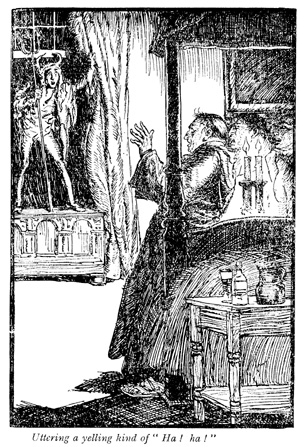
“Exorciso te,” stammered one.
“Ha! ha! ha! ha!” repeated Jack, entering the room, and taking up the paper, which he burnt by the flame of the candle. Our hero looked at the old man on the bed; his jaw had fallen, his eyes were turned. He was dead. Jack then gave one more “ha! ha! ha! ha!” to keep the priests in their places, blew out the candles, made a spring out of the window, caught up his cloak, and disappeared as fast as his legs could carry him.
Jack ran until he was out of breath, and then he stopped, and sat down by the side of the road. It was broad moonlight, and Jack knew not where he was: “but Minorca has not many high roads,” thought Jack, “and I shall find my way home. Now, let me see—I have done some good this evening. I have prevented those rogues from disinheriting a family. I wonder who they are; they ought to be infinitely obliged to me. But if the priests find me out, what shall I do? I never dare come on shore again—they’d have me in the inquisition. I wonder where I am,” said Jack; “I will get on that hill, and see if I can take a departure.”
The hill was formed by the road being cut perpendicularly almost through it, and was perhaps some twelve or fourteen feet high. Jack ascended it, and looked about him. “There is the sea, at all events, with the full moon silvering the waves,” said Jack, turning from the road; “and here is the road; then that must be the way to Port Mahon. But what comes here?—it’s a carriage. Why, it’s the yellow carriage of that old lady with her diamonds, and her two splashy footmen!” Jack was watching it as it passed the